Case 1 - Refractory Ventricular Fibrillation and Advanced Defibrillation Strategies
-
Ventricular fibrillation (VF) is a common initial rhythm in both out-of-hospital and in-hospital cardiac arrest and remains one of the most immediately life-threatening arrhythmias encountered in acute care. Defibrillation combined with high-quality cardiopulmonary resuscitation (CPR) is the cornerstone of treatment. However, a substantial proportion of patients remain in shock-refractory ventricular fibrillation, defined as persistent VF despite multiple appropriately delivered defibrillation attempts.
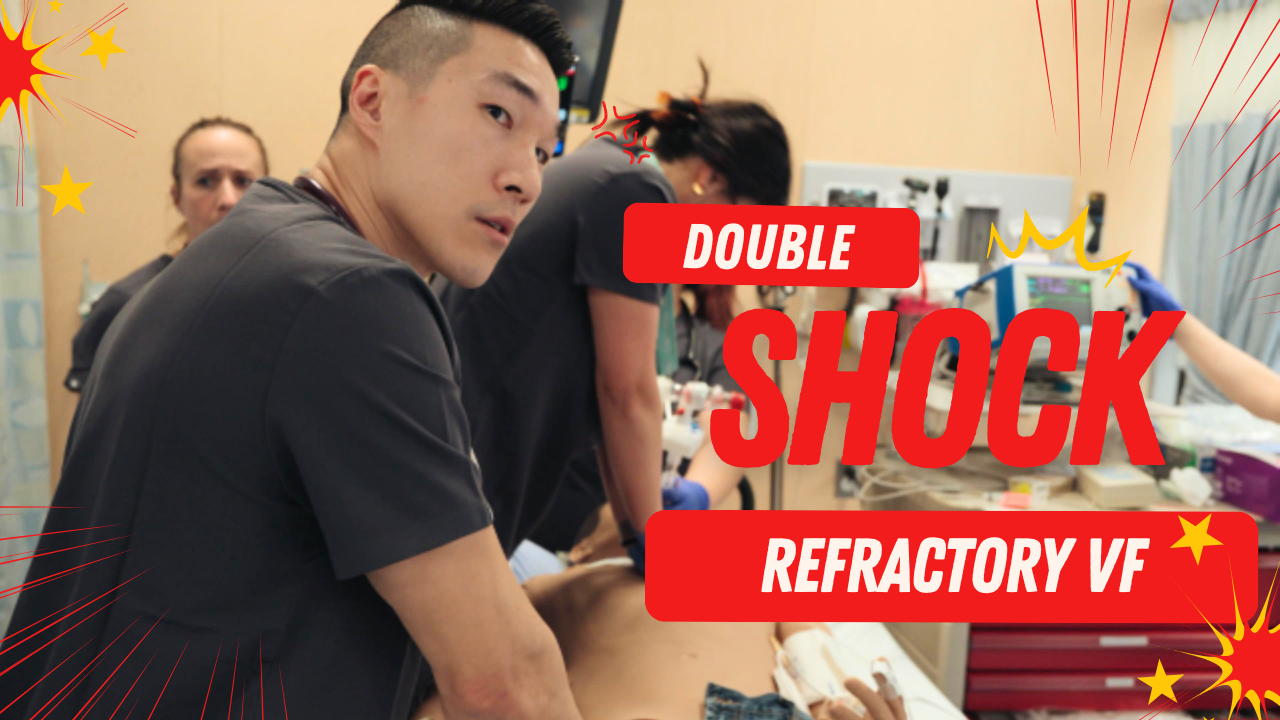
This simulation depicts the management of refractory ventricular fibrillation, with particular emphasis on evidence-based escalation strategies when standard defibrillation fails.
-
Pulseless ventricular fibrillation is treated using the Advanced Cardiac Life Support (ACLS) cardiac arrest algorithm, which prioritizes early defibrillation, uninterrupted high-quality CPR, and rapid identification of reversible causes.
Key components of the pulseless VF / pulseless VT algorithm include:
1. Immediate High-Quality CPR
Chest compressions at 100–120/min
Compression depth 5–6 cm in adults
Full chest recoil and minimal interruptions
Early airway management without delaying defibrillation
High chest compression fraction and minimizing pre- and post-shock pauses are strongly associated with improved outcomes.
2. Early Defibrillation
Immediate unsynchronized biphasic defibrillation as soon as VF is identified
Subsequent shocks delivered every 2 minutes, coordinated with rhythm checks
Pads typically placed in the anterior–lateral position for initial shocks
3. Vasopressor Therapy
Epinephrine 1 mg IV/IO every 3–5 minutes after the second defibrillation attempt
Intended to improve coronary and cerebral perfusion pressure during CPR
4. Antiarrhythmic Therapy
Amiodarone or lidocaine may be administered for persistent VF after multiple shocks
These agents reduce recurrence of VF but have not consistently demonstrated improvement in survival to hospital discharge
5. Identification of Reversible Causes
Ongoing evaluation for the Hs and Ts (hypoxia, hypovolemia, hydrogen ion [acidosis], hypo/hyperkalemia, hypothermia, tension pneumothorax, tamponade, toxins, thrombosis)
Despite optimal execution of these steps, approximately half of patients with initial VF may remain refractory after multiple defibrillation attempts.
-
Refractory VF is generally defined as:
Persistent VF after three consecutive defibrillation attempts, each separated by 2 minutes of CPR, using standard pad positioning and appropriate energy levels.
Once VF becomes refractory, simply repeating identical shocks is often ineffective. This has prompted investigation into alternative defibrillation strategies aimed at:
Altering the myocardial electrical vector
Increasing delivered energy
Improving myocardial voltage gradients
-
Vector-Change Defibrillation
Vector-change defibrillation involves relocating defibrillation pads from the standard anterior–lateral position to an anterior–posterior configuration. This changes the electrical pathway through the myocardium and may better capture regions of the left ventricle that are inadequately defibrillated with standard pad placement.
Double Sequential External Defibrillation (DSED)
Double sequential external defibrillation involves:
Two defibrillators
Two sets of pads placed in different planes (typically anterior–lateral and anterior–posterior)
Two shocks delivered in rapid sequence (within <1 second), rather than simultaneously
Theoretical mechanisms include:
Higher total delivered energy
A “conditioning” first shock that alters myocardial refractoriness, allowing the second shock to terminate VF more effectively
Improved voltage gradients in myocardial regions prone to re-initiating fibrillation
-
The DOSE VF trial, a multicenter cluster-randomized controlled trial conducted across six Canadian paramedic services, provides the strongest evidence to date evaluating these strategies.
In this study:
Adult patients with out-of-hospital cardiac arrest and refractory VF after three standard defibrillation attempts were randomized to:
Continued standard defibrillation
Vector-change defibrillation
Double sequential external defibrillation
Key Findings:
Survival to hospital discharge was significantly higher in:
DSED (30.4%) compared with standard defibrillation (13.3%)
Vector-change defibrillation (21.7%) compared with standard defibrillation
Good neurologic outcome (modified Rankin score ≤2) was significantly higher with DSED
Rates of VF termination and return of spontaneous circulation were also highest in the DSED group
Importantly, these benefits were observed in the setting of:
High-quality CPR
Similar timing and dosing of epinephrine and antiarrhythmic medications across groups
No reported defibrillator damage or safety concerns with DSED
These findings suggest that early escalation to vector-change defibrillation or DSED, rather than repeated identical shocks, may meaningfully improve outcomes in refractory VF.
-
This simulation is designed to:
Demonstrate structured, team-based management of refractory ventricular fibrillation
Highlight decision-making around escalation beyond standard defibrillation
Reinforce the importance of CPR quality, timing, and coordination during high-acuity resuscitations
Translate emerging evidence into practical bedside and prehospital application
While protocols and scope of practice vary by institution and region, the principles demonstrated reflect current evidence and evolving best practices in cardiac arrest management.
-
Cheskes S, Verbeek PR, Drennan IR, et al. Defibrillation Strategies for Refractory Ventricular Fibrillation. New England Journal of Medicine. 2022;387:1947–1956. DOI: 10.1056/NEJMoa2207304.
NEJMoa2207304American Heart Association. Adult Advanced Cardiovascular Life Support Guidelines. Circulation. 2015 & 2020 updates.
Kudenchuk PJ, et al. Amiodarone, Lidocaine, or Placebo in Out-of-Hospital Cardiac Arrest. New England Journal of Medicine. 2016.
Ideker RE, et al. Current Concepts for Selecting Defibrillation Electrode Location. Pacing and Clinical Electrophysiology. 1991.